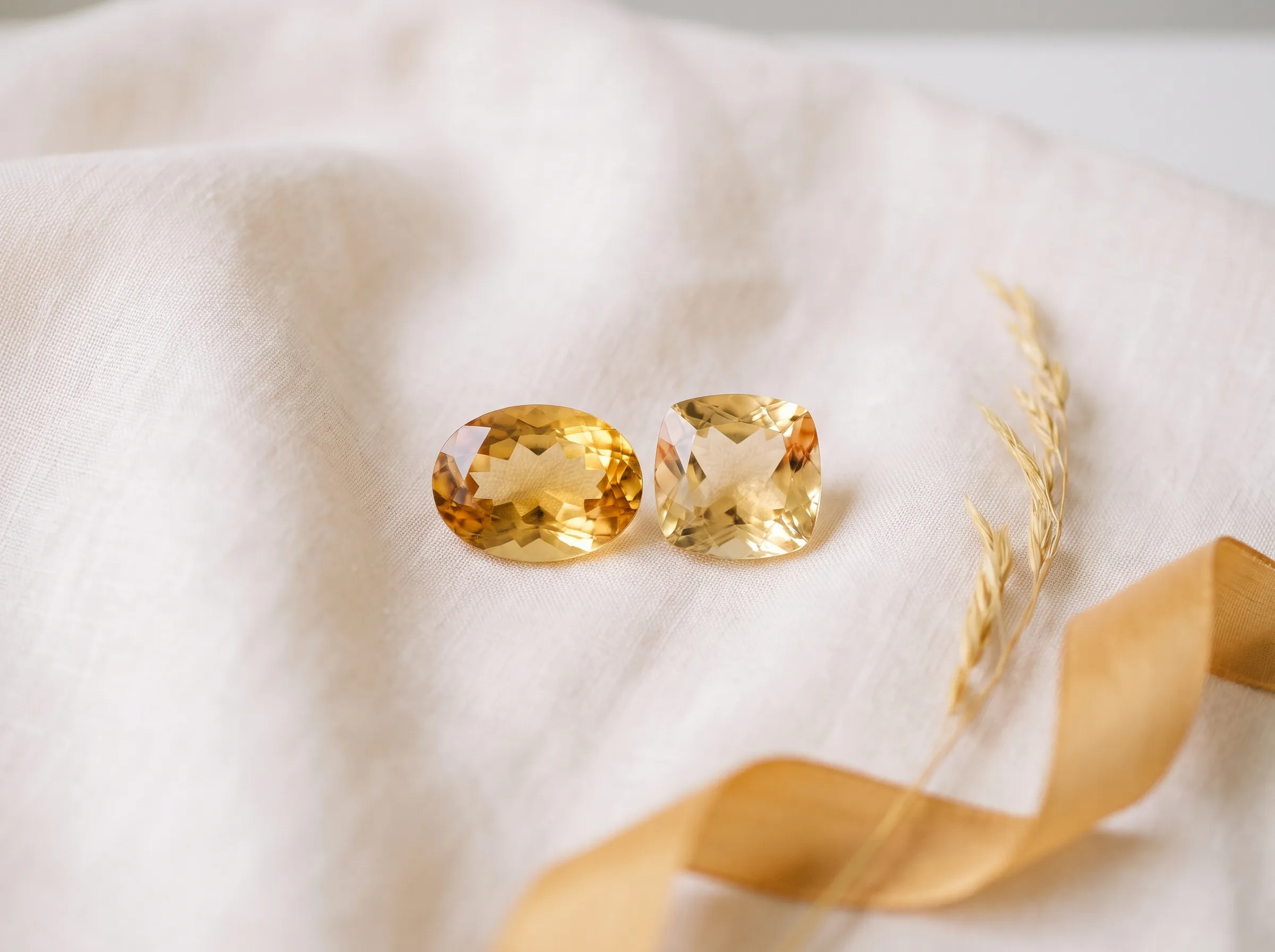
November Birthstone
Born in November? You get two stones in warm shades of gold. November's birthstones are topaz and citrine, and for decades citrine was sold under topaz's name. Since at least the 1890s, jewelers have said topaz stands for friendship and fidelity, which makes it a lovely gift for a close friend.
November birthstone colors
There's no single official birthstone chart. In the US, four jewelry trade groups each publish their own list: the Gemological Institute of America (GIA), the American Gem Trade Association, the American Gem Society, and Jewelers of America. For November, all four agree on topaz and citrine.
| Stone | Color |
|---|---|
| Golden topaz | Yellow to amber |
| Imperial topaz | Orange to pink-orange |
| Blue topaz | Blue |
| Citrine | Pale yellow to brownish orange |
Topaz comes in other colors, too, including pink, violet, brown, and, very rarely, red. But gold is November's classic color, and citrine is a close match for golden topaz.
So close that for decades, a lot of the "topaz" in American jewelry stores wasn't topaz at all. That mix-up is how November ended up with two birthstones.
Why November has two birthstones
Topaz got there first. The gem expert George Frederick Kunz collected eight older birthstone lists, from ancient Rome to Poland and Russia, and all eight gave November to topaz. Tiffany & Co. even printed a rhyme about it in 1870, although nobody knows who wrote it:
Who first comes to this world below
With drear November's fog and snow,
Should prize the topaz's amber hue,
Emblem of friends and lovers true.
By 1903, topaz had a reputation problem. Forty years earlier it had been a popular gem, and since then its price had fallen by roughly 70 percent.
Oliver Farrington, the geology curator at Chicago's Field Museum, suspected he knew why. A buyer couldn't be sure a topaz was really topaz: "numerous other stones of inferior quality masquerade under its name." The most common was "simply smoky quartz, heated until it turns a yellow color." Yellow quartz like that is called citrine, and it ended up sharing November, but that took a few decades.
In 1912, a national association of retail jewelers, known today as Jewelers of America, voted on one official birthstone list. Topaz got November to itself.
But citrine kept selling under topaz's name, and by 1946 a North Carolina paper was calling them "the two birthstones for November."
It took the jewelers fifty years to agree. In 1954, the Jewelry Industry Council said that "most of the stones the jeweler knows as topaz actually are members of the quartz family."
By 1963, a Florida jeweler's ad was telling customers that topaz and citrine "each may be worn as the birthstone for November and each is a genuine stone."
Today all four groups list citrine, right beside the stone whose name it borrowed for so long.
- 1870TopazTiffany prints the rhyme
- 1892TopazTiffany booklet: "Friendship and Fidelity"
- 1903A museum curator warns that yellow quartz sells as topaz
- 1912TopazThe jewelers' list gives November topaz alone
- 1946TopazCitrine"The two birthstones for November"
- 1952TopazJewelry Industry Council list
- 1954The Council: "most" topaz is really quartz
- TodayTopazCitrineAll four groups list both
Topaz, the oldest November stone
Topaz takes its name from an island that never had any.
The island was Topazios, in the Red Sea. The Roman writer Pliny said it was so wrapped in fog that sailors had to search for it. A green stone came from there, and it was given the name topaz. The first one went as a gift to Queen Berenice of Egypt, and we now believe it was a gem we call peridot.
So how did the name reach the gold stone we know today? At some point it simply moved over, and it's hard to say when.
That means the topaz in November's oldest lists was very likely green, and wasn't actually topaz.
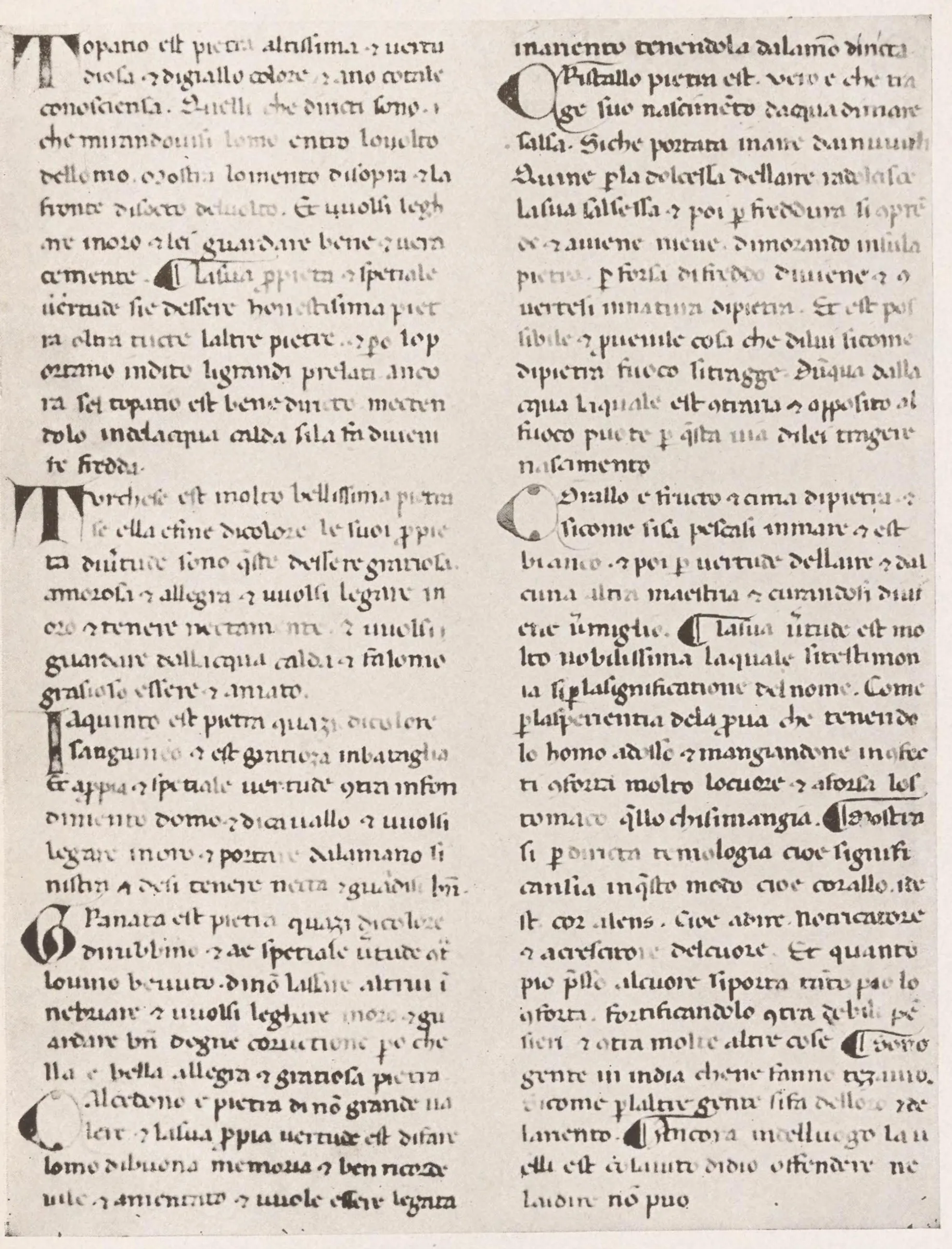
Old folklore assigned topaz some surprising powers.
From the 1300s to the 1600s, Europeans thought it could break magic spells and calm anger. A medieval book of talismans went further, promising that a falcon carved on a topaz would win you "the goodwill of kings, princes, and magnates." Another legend tells of a topaz, given to a monastery by a Dutch countess, that supposedly glowed so brightly the monks could read their prayers by it at night.
The real stone has one surprising power of its own: it's heavy.
People who handled gems could "frequently pick out the topaz from a miscellaneous lot of precious stones without removing their wrappings." One stone weighed nearly four pounds, perhaps the largest cut topaz of its day. It was a gift to Pope Leo XIII for his silver jubilee in 1902.
Topaz had its own turn as an impostor.
The crown of Portugal held a stone called the Braganza, said to be a diamond of 1,680 carats. For scale, the Hope Diamond is only about 45 carats. However, one expert thought it was probably a topaz.
The most prized topaz today is imperial topaz, a rare orange to pink-orange stone mined in Brazil. Nobody knows for sure where the name came from. It may honor a Russian czar, or Brazil's Emperor Pedro II, who was given reddish topaz in 1881.
Citrine, the November stone with a borrowed name
Citrine has a perfectly good name of its own, from citron, the French word for lemon. It turns up in reports of Roman jewelry, and it was popular in Scotland in Victorian times. It even inherited some of topaz's folklore: because the two were so often confused, people came to believe citrine could soothe a temper as well.
Natural citrine is rare, though. Most of what's sold today is amethyst, mined mostly in Brazil and heated until it turns gold. People have been doing that for more than a century.
The natural kind does exist, and one important source comes with a legend. The Anahí mine sits inside the world's largest freshwater wetland, in Bolivia. The story goes that in the 1600s, a Spanish conquistador married a native princess named Anahí, and the mine was her dowry. He presented some of its stones to his queen. Then the mine was lost for more than three centuries, until it turned up again in the 1960s. It still carries the princess's name.
How to tell if topaz and citrine are natural
Most citrine and nearly all blue topaz get their color from treatment, and that's normal. They're still real stones. Here's what the words on a listing or a tag mean:
- Natural citrine: unheated, and rare.
- Citrine: on its own, most likely heated amethyst.
- Blue topaz: colorless topaz turned blue by irradiation, a treatment first used in 1957. The color is permanent. Jewelers of America also lists it for December.
- Mystic topaz: colorless topaz with a thin artificial coating on top.
- Imperial topaz: the rare orange to pink-orange stones. Some dealers want a reddish tone before they use the name.
- Smoky topaz or quartz topaz: old trade names for quartz, so these aren't topaz.
None of these treatments is a problem, as long as the seller tells you. The US Federal Trade Commission's jewelry guides say a seller should mention any treatment that isn't permanent, needs special care, or makes a big difference to what the stone is worth. When you shop online, look for it in the product description.
Even the word "birthstone" has rules. The FTC's guides say a lab-made or imitation stone should only be called one if a word like "simulated" or "laboratory-created" comes right before it, just as easy to read. So if a listing simply says "birthstone," it should be the real thing.
What makes one topaz worth more than another? Mostly its color.
Imperial and red stones sit at the top, with pink next. Yellow and golden stones are much more abundant, so they cost less.
Blue topaz costs the least. Treated stones reached the market in the late 1970s, and so many were made that the price fell.
Citrine is easy on the budget: even a fine one is modest, and a bigger stone doesn't cost much more per carat.
A little care keeps both stones bright.
Clean topaz in warm, soapy water, and skip the steam cleaner and the ultrasonic. Some yellow to brown topaz can fade after long exposure to light or heat. Abrasive cleaners or a jeweler's buffing wheel can take the coating off mystic topaz, so let your jeweler know before any cleaning.
Citrine is easier. Warm, soapy water works, and an ultrasonic cleaner is usually safe, but skip the steam.
Giving a November birthstone
November's meaning has barely changed in seventy years. Tiffany's 1892 booklet gave topaz "Friendship and Fidelity," and in 1963 a Florida jeweler was still calling it a stone of loyalty.
So a November stone works for a best friend, birthday or not. It also says something sweet to a husband or wife of many years.
Citrine is the easygoing choice, modest in price and tough enough to wear every day.
Topaz is actually the harder of the two, but a hard knock can chip or crack it. For someone who's rough on rings, we'd pick a topaz pendant or earrings.
Shopping for a Texan? Blue topaz has been the Texas state gem since 1969. It even has its own Lone Star cut, designed by Gary and Paul Worden of San Angelo.
For a gift nobody else will have, add words of your own. People once carved mottoes on topaz, so an engraved topaz or citrine picks up an old habit. The gem expert George Kunz described one, owned by a man in Naples, that read "Nature fails, fortune changes, God sees all."
And November's stones aren't only for birthdays. GIA's gem experts list them for anniversaries, too: blue topaz for the 4th anniversary, citrine for the 13th anniversary, and imperial topaz for the 23rd anniversary.
If you're giving a claddagh ring, a November stone in the heart makes it theirs.
What to look for in November birthstone jewelry
As an Amazon Associate, we earn from qualifying purchases.
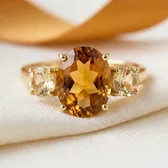
- Golden topaz is the classic, the "amber hue" of the old rhyme, and it's what we'd pick first.
See golden topaz rings on Amazon - A citrine ring or pendant is the everyday choice, warm in color and modest in price.
See citrine rings on Amazon - Topaz and citrine together puts the old stone and the newer one side by side.
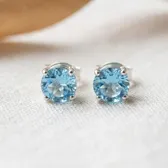
See topaz and citrine jewelry on Amazon - Blue topaz earrings are the budget pick. The blue comes from treatment, and it's permanent.
See blue topaz earrings on Amazon - A November birthstone necklace with a small stone is easy to give when you don't know their ring size.
See November birthstone necklaces on Amazon - Imperial topaz is the splurge, so we'd buy it from a seller who can tell you where it was mined.
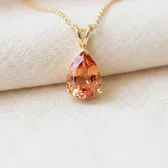
See imperial topaz pendants on Amazon
Sources
- George Frederick Kunz, The Curious Lore of Precious Stones, 1913
- George Frederick Kunz, Natal Stones: Sentiments and Superstitions Connected with Precious Stones, Tiffany & Co., 1892
- Oliver Cummings Farrington, Gems and Gem Minerals, 1903
- Pliny the Elder, Natural History, book 37, translated by D. E. Eichholz, 1962
- GIA, "November Birthstones," "Topaz History and Lore," "Topaz Quality Factors," "Citrine," and "Citrine History and Lore"
- GIA, "Ametrine History and Lore"
- GIA, "Historical Reading List: Imperial Topaz from Minas Gerais"
- Jewelers of America, "Birthstones"
- American Gem Society, "November Birthstones"
- American Gem Trade Association, birthstones page
- Bassoo, Eames, Hardman, Befus, and Sun, "Texas topaz," Gems & Gemology, Winter 2023
- Evening Star (Washington, D.C.), "For uniform list," August 7, 1912
- Topeka State Journal, August 8, 1912
- Beatrice Daily Express (Nebraska), "Jewelers accept new birth stones," August 9, 1912
- Wilmington Morning Star (North Carolina), November 12, 1946
- The Journal (Caldwell, Ohio), "Your birthstone," November 11, 1954
- Gadsden County Times (Quincy, Florida), jeweler's advertisement, November 7, 1963
- Federal Trade Commission, Jewelry Guides, 16 CFR 23.24 to 23.26
- Smithsonian National Museum of Natural History, "Hope Diamond"