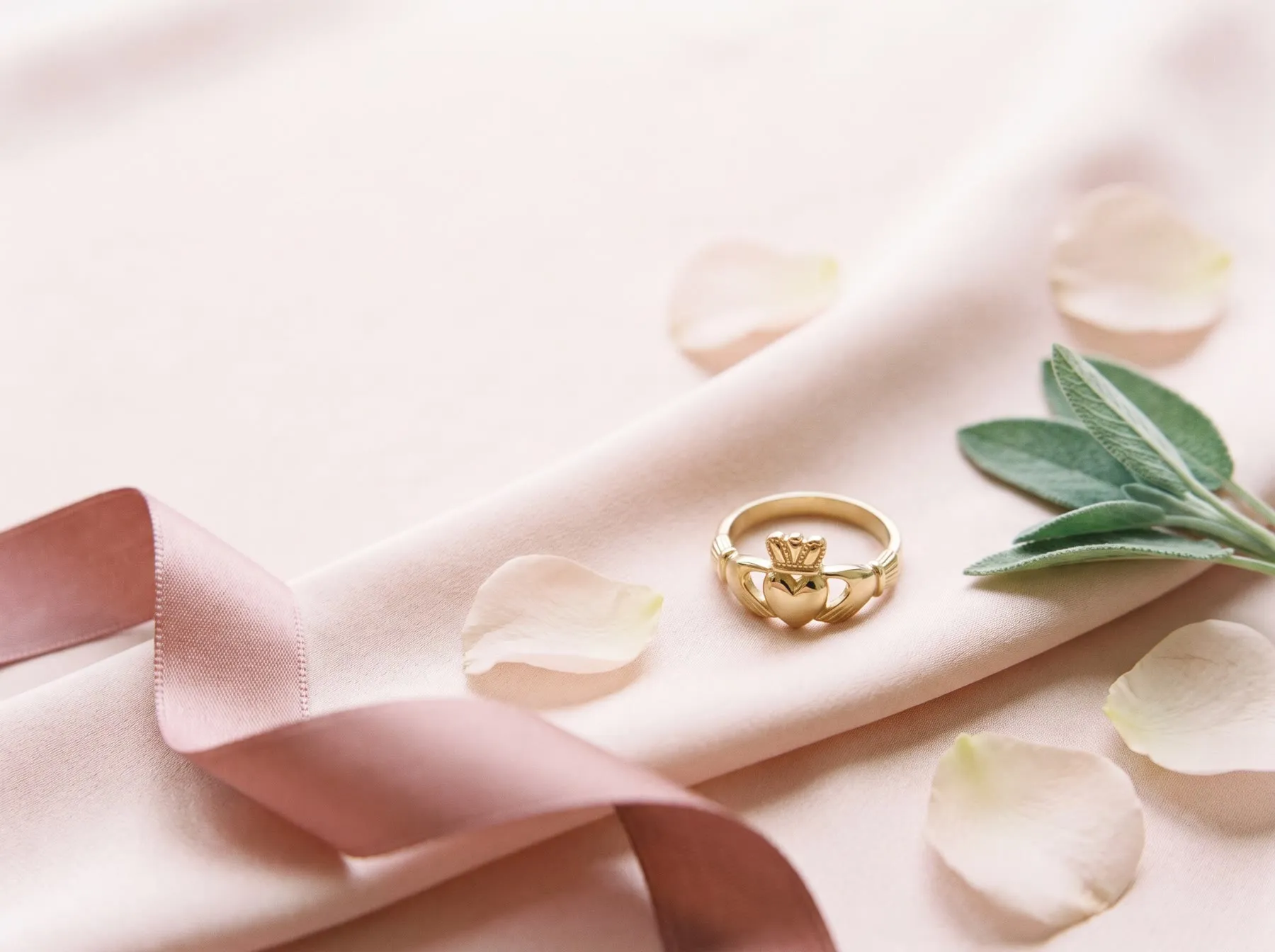
The Claddagh Ring
Two hands hold a heart, and the heart wears a crown. The hands are friendship, the heart is love, and the crown is loyalty. The ring takes its name from the Claddagh, a little fishing village on the edge of Galway, in the west of Ireland. You say it "KLAD-uh," which comes from the Irish word for a shore.
How to wear a claddagh ring
The way you wear a claddagh tells people where your heart is. This is the version you'll hear most often:
| Hand | Heart points toward | Meaning |
|---|---|---|
| Right | your fingertips | Single, heart open |
| Right | your wrist | In a relationship |
| Left | your fingertips | Engaged |
| Left | your wrist | Married |
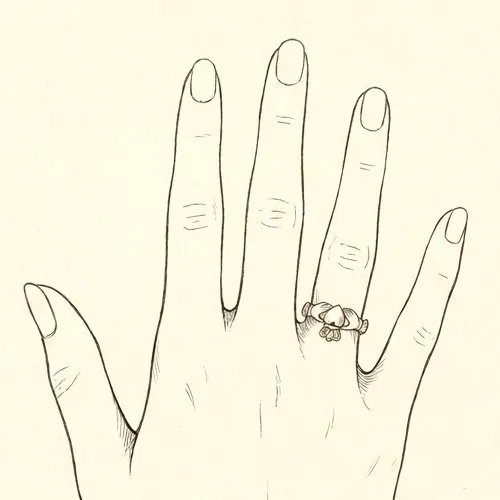
Right · your fingertips
Single, heart open
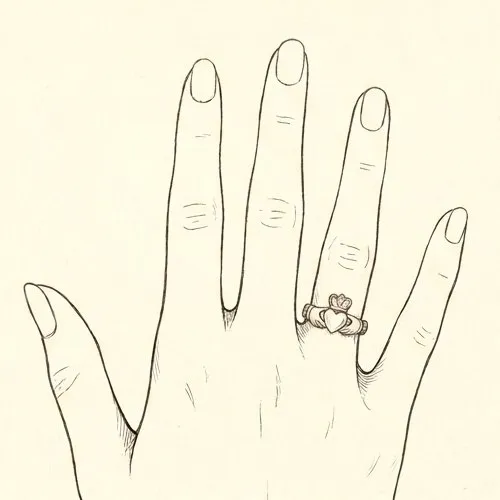
Right · your wrist
In a relationship
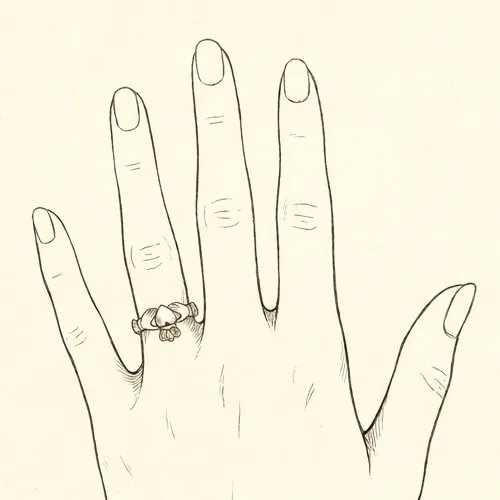
Left · your fingertips
Engaged
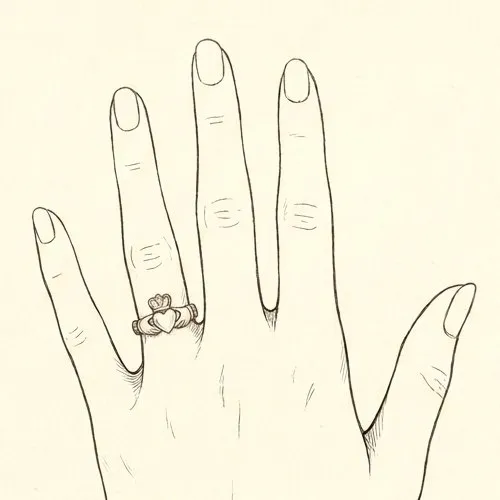
Left · your wrist
Married
An easy way to remember it: when the heart points out toward your fingertips, your heart is still open. When it points back toward your wrist, your heart belongs to someone.
The chart matches the Irish custom of wearing a wedding ring on the left hand, the same as in America. In some countries, wedding rings are worn on the right hand instead. Take that into account if you're giving one to a person from another country.
Nobody really knows where these rules started. The National Museum of Ireland describes a simpler way with only three positions, where the left hand just means married. Other places have their own variations, and most of what people know about wearing a claddagh was passed along by word of mouth rather than written down. So if your grandmother wore hers differently from the chart, she wasn't getting it wrong.
The village behind the name
The Claddagh was a fishing village just outside Galway City. In the 1800s it was a cluster of thatched cottages along crooked lanes, and it had something few places in Ireland had: its own king. About a hundred years ago Ireland had over a dozen of these village kings, and most of them lived on remote islands off the west coast. The Claddagh's lived right across the water from a city. Every year on the 23rd of June the villagers chose their king, who settled their disputes. The title lives on today as an honorary one.
The story of Richard Joyce
Ask in Galway who made the first claddagh and someone will tell you about Richard Joyce.
Around 1675, the story goes, a young Galway man named Joyce set sail for the West Indies and never got there. Algerian corsairs captured his ship, and he was sold in Algiers to a wealthy goldsmith. His new master found him "tractable and ingenious" and taught him the trade. Joyce quickly became a fine goldsmith, but he was still a slave, and he would stay one for about fourteen years.
Then, in 1689, William III took the English throne and demanded that Algiers free the British subjects it held as slaves. Joyce was one of them. His master tried to keep him, offering his only daughter in marriage and half of everything he owned if Joyce would stay. Joyce refused all of it and sailed home to Galway.
Why would a man walk away from a fortune and a bride? The whole story comes from James Hardiman's History of Galway, written in 1820, and he doesn't say. He tells us only that Joyce married back home, did well as a goldsmith, and left silver work "stamped with his mark" that was still around in Hardiman's day. He never mentions a ring. Later storytellers supplied the answer.
In the legend, Joyce had left a sweetheart behind in Galway, and through all his years in Algiers he never forgot her. While he was still a slave, he made a ring for her and kept it with him. And she waited. When he finally came home, he gave her the ring. It's easy to see why that version stuck.
Galway tells an even older Joyce story about a ring, and some versions say it was the very first claddagh. Margaret Joyce, remembered as Margaret of the Bridges, lived generations before Richard. Both came from the Joyces, one of the fourteen merchant families known as the Tribes of Galway, though no record we found says exactly how the two were related. Margaret is said to have paid for bridges all across Connacht. One day, as she sat watching the builders, an eagle flew over and dropped a gold ring into her lap. In the telling Hardiman found, written down in 1661, the ring held a brilliant stone that no gem expert could ever identify. Her family kept it as a sign from heaven that her good works had been noticed. Hardiman called the story a fable, but he noted that some of the family still believed it.
The oldest claddagh ring
For all the legends, there is one piece of hard evidence, and it's small enough to fit on a finger. It's a gold ring about 320 years old, and stamped inside it, twice, is Richard Joyce's own mark: "RI."
Whatever the truth of his story, the man was real, and so is his ring.
The curators at Galway City Museum think it was probably made for a man. Engraved inside, along with Joyce's mark, are two more sets of initials. These weren't his. They belonged to people who once owned the ring, probably people of some standing. Who they were is still a mystery.
For decades the ring belonged to a collector named Garech Browne, who kept it at Luggala, his estate in the Wicklow Mountains south of Dublin. Browne had founded a record label and named it, of all things, Claddagh Records. When his collection went to auction at Sotheby's in London in early 2020, the ring was expected to sell for up to £2,500. A bidding war took it to £8,125, and Galway City Museum brought it home.
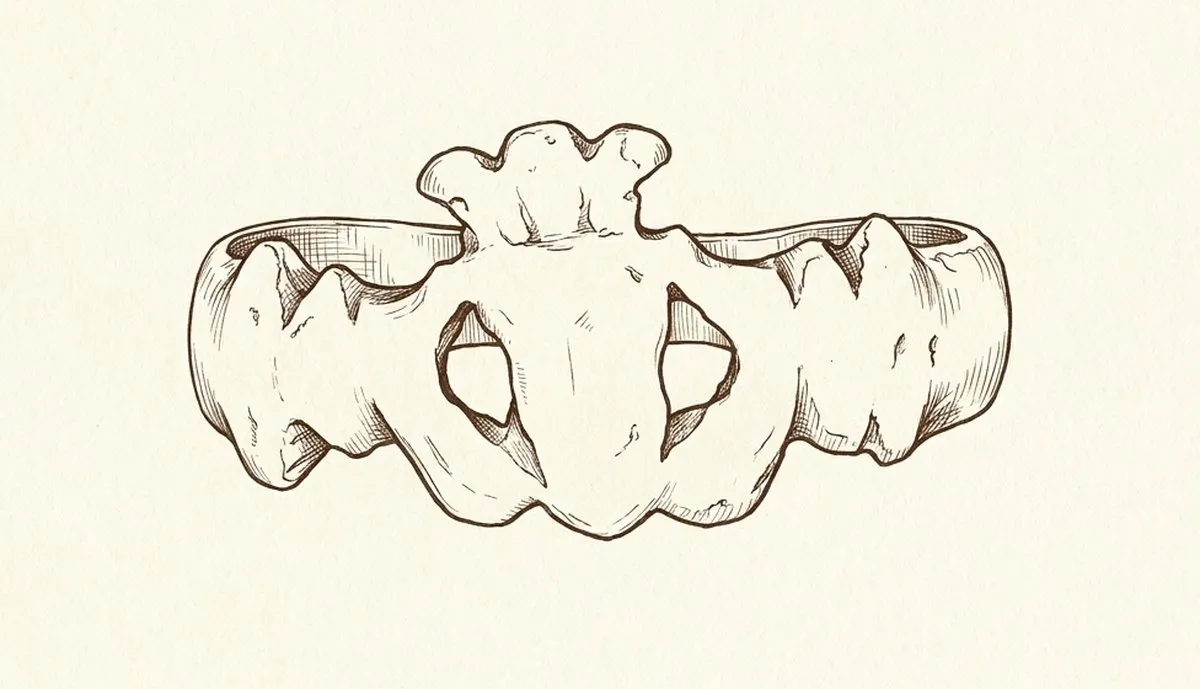
Eoin O'Neill, who looked after the museum's collection when the ring came home, has a lovely theory about those initials. Maybe, he suggests, they belong to a mother and her daughter. Claddaghs were often handed down that way, from one generation of women to the next, and it's easy to picture this little ring passing from a mother's hand to her daughter's. He also points out that claddaghs were given as tokens of friendship. Either way, the oldest claddagh we know of may never have been a wedding ring at all.
Where the design comes from
People were making promises with clasped hands long before anyone made a claddagh. In ancient Rome, two people joined right hands to seal an agreement, a gesture they called dextrarum iunctio.
The Romans put that handclasp on their rings, and the little design outlived Rome by more than a thousand years. Medieval Italians called these "fede" rings, from mani in fede, "hands clasped in trust," and all across Europe they became the ring you gave the person you meant to marry. In Elizabethan England, a gold ring could even serve as proof that a promise to marry had been made. And sometime in the 1500s, jewelers began tucking a little heart between the clasped hands.
Then, around 1700, Galway's goldsmiths set a crown on that heart, and the claddagh as we know it appeared. For generations it was Galway's own ring. By the middle of the 1800s people thought of it as the Claddagh's ring, and as late as 1905 a local jeweler named William Dillon wrote that it was worn "roughly from the Aran isles on the west, all through Connemara and Joyce's Country." That's a stretch of Ireland's rugged west coast, and not much farther.
It didn't stay there. In the century since, the claddagh has become a symbol of Ireland itself. Today you'll find it worn all over the world, not just by people with Irish roots.
Giving a claddagh ring
Claddaghs have long passed from mother to daughter, and handing yours down keeps that going. If you're buying a new one, you get to start the tradition in your family.
Plenty of couples choose it as an engagement or wedding ring, because the promise is built right into the design. It's just as fitting for a close friend, since the hands stand for friendship.
It isn't just for women. The oldest claddagh we know of was probably made for a man.
For anyone with Irish roots, or anyone who loves Ireland, it's an easy choice.
You might hear that it's bad luck to buy a claddagh for yourself. When we looked, we found plenty of people who repeat this, but no sign of it in older writing about the ring. So if you'd like one, go ahead and treat yourself.
What to look for
As an Amazon Associate, we earn from qualifying purchases.
- Plain gold is closest to the oldest claddagh we know of, which has no stones at all.
See gold claddagh rings on Amazon - Sterling silver is easy to wear every day, and it's what we'd pick for a friend.
See sterling silver claddagh rings on Amazon - A birthstone heart adds a little something of the person you're giving it to.
See birthstone claddagh rings on Amazon - A necklace or earrings suit someone who doesn't wear rings, and they save you from guessing a ring size when it's a surprise.
See claddagh necklaces on Amazon - A men's band is a good fit if he'd rather not wear something delicate.
See men's claddagh rings on Amazon - Solid gold with a diamond heart is the one we'd choose for an engagement, or whenever you want it to feel like an heirloom.
See diamond claddagh rings on Amazon
Older love rings worth knowing
There are a number of love rings far older than the claddagh, and each of them makes a lovely gift.
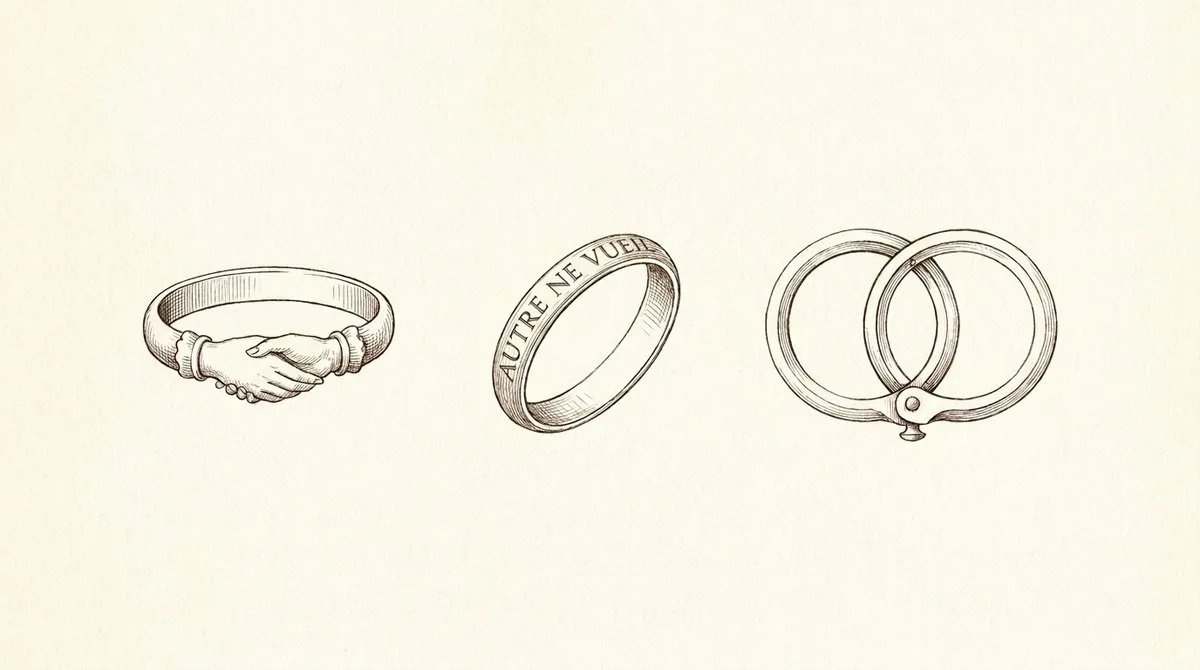
The fede ring is the claddagh's ancestor. In its oldest form it's just two hands clasped together, with no heart and no crown. If the claddagh feels like a lot of ring, the fede makes the same promise more quietly.
The posy ring is a band engraved with a few words, a little verse or "poesy" that gave the ring its name. In 1550, John Bowyer of Lincoln's Inn in London gave his bride one that read Deus nos iunxit, "God joins us together." Some lines turned up on ring after ring, and one of the loveliest is autre ne vueil: "I desire no other."
The gimmel ring is two hoops that slide together and lock into one. The name comes from the Latin word for twin. There's one at the London Museum, from around 1600, with a secret motto split between its two halves. You can only read it when the hoops come apart: "AS HANDES DOE SHUT" on one half, and "SO HART BE KNIT" on the other.
As an Amazon Associate, we earn from qualifying purchases.
- An engraved posy ring lets you give the words instead of the symbol, and we think choosing them is half the fun.
See engraved posy rings on Amazon - A clasped-hands fede ring goes all the way back to where the claddagh began.
See clasped-hands rings on Amazon
Sources
- National Museum of Ireland, "Claddagh Rings," curator's note by Hannah Gallagher
- Galway City Museum, "Richard Joyce and the oldest known Claddagh ring," Eoin O'Neill, 2020
- James Hardiman, The History of the Town and County of the Town of Galway, 1820
- The Irish Times, "Eternal love: Oldest-known Claddagh ring comes home to Galway," Elizabeth Birdthistle, April 2020
- Victoria and Albert Museum, collection records for fede, gimmel, and posy rings
- London Museum, collection record for a gold gimmel ring, late 16th to early 17th century
- National Geographic, "Claddagh rings and the Barbary corsairs"
- The Irish Catholic, John Wyse Jackson, review of The Last Blasket King, June 2015
- RTÉ Brainstorm, "Claddagh ring history and folklore," Marion McGarry, February 2026
- Merriam-Webster, "claddagh"
- Niall Ó Dónaill, Foclóir Gaeilge–Béarla, 1977, "cladach"